FUST Lab’s ultrasonic-based advanced oxidation process
provides a safer and more sustainable water treatment solution,
realizing both environmental protection and energy efficiency.
provides a safer and more sustainable water treatment solution,
realizing both environmental protection and energy efficiency.
Water Treatment Application Data
A company that changes the world through technology,
FUST Lab.
FUST Lab.
Ultrasonic Microbubble
Ultrasonic Microbubble Advanced Oxidation Process
PFAS Decomposition (Non-incineration, No Ozone / H₂O₂)
PFAS (Per- and Polyfluoroalkyl Substances) are representative environmental contaminants
known as “forever chemicals” due to their high stability and extreme resistance to degradation.
Even at low concentrations, PFAS can cause endocrine disruption, carcinogenicity, and reproductive toxicity.
The United States, Europe, and Japan have implemented strict regulations, and further tightening of industrial discharge standards is expected.
Currently, PFAS lack effective destruction technologies and are typically removed by filtration followed by incineration, resulting in high carbon emissions, air pollution, and significant costs.
Unlike conventional advanced oxidation processes (AOP), CAVITOX does not use ozone or hydrogen peroxide. Instead, it utilizes focused ultrasonic technology to break the molecular chains of toxic substances such as PFAS, converting organic compounds into inorganic forms without incineration or secondary treatment, providing an environmentally friendly solution.
Even at low concentrations, PFAS can cause endocrine disruption, carcinogenicity, and reproductive toxicity.
The United States, Europe, and Japan have implemented strict regulations, and further tightening of industrial discharge standards is expected.
Currently, PFAS lack effective destruction technologies and are typically removed by filtration followed by incineration, resulting in high carbon emissions, air pollution, and significant costs.
Unlike conventional advanced oxidation processes (AOP), CAVITOX does not use ozone or hydrogen peroxide. Instead, it utilizes focused ultrasonic technology to break the molecular chains of toxic substances such as PFAS, converting organic compounds into inorganic forms without incineration or secondary treatment, providing an environmentally friendly solution.
Complete degradation to non-detectable levels confirmed for over 11 PFAS species of varying chain lengths in actual wastewater
| Sample | Cavitox | Results per toxin [ppb] | |||||||||||
|---|---|---|---|---|---|---|---|---|---|---|---|---|---|
| PFOA | br_PFOS | L-PFOS | PFBA | PFP eA | PFDA | PFHpA | PFHxA | PFOA | PFOA | PFOA | PFOA | ||
| PFAS-detected Groundwater A | Before treatment | 2.07 | 0.104 | - | 1.86 | 1.09 | 0.127 | 0.449 | 1.24 | 0.130 | - | 0.251 | 0.045 |
| After treatment | N.D. | N.D. | N.D. | N.D. | N.D. | N.D. | N.D. | N.D. | N.D. | N.D. | N.D. | N.D. | |
| PFAS-detected Groundwater B | Before treatment | 0.592 | 0.155 | - | 0.782 | 0.390 | - | 0.202 | 0.515 | - | 0.097 | 0.325 | 0.045 |
| After treatment | N.D. | N.D. | N.D. | N.D. | N.D. | N.D. | N.D. | N.D. | N.D. | N.D. | N.D. | N.D. | |
| PFAS-detected Tap Water C | Before treatment | 10.4 | 0.336 | 0.325 | 4.32 | 1.13 | 0.300 | 1.72 | 2.16 | 1.00 | 0.184 | 0.606 | - |
| After treatment | N.D. | N.D. | N.D. | N.D. | N.D. | N.D. | N.D. | N.D. | N.D. | N.D. | N.D. | N.D. | |
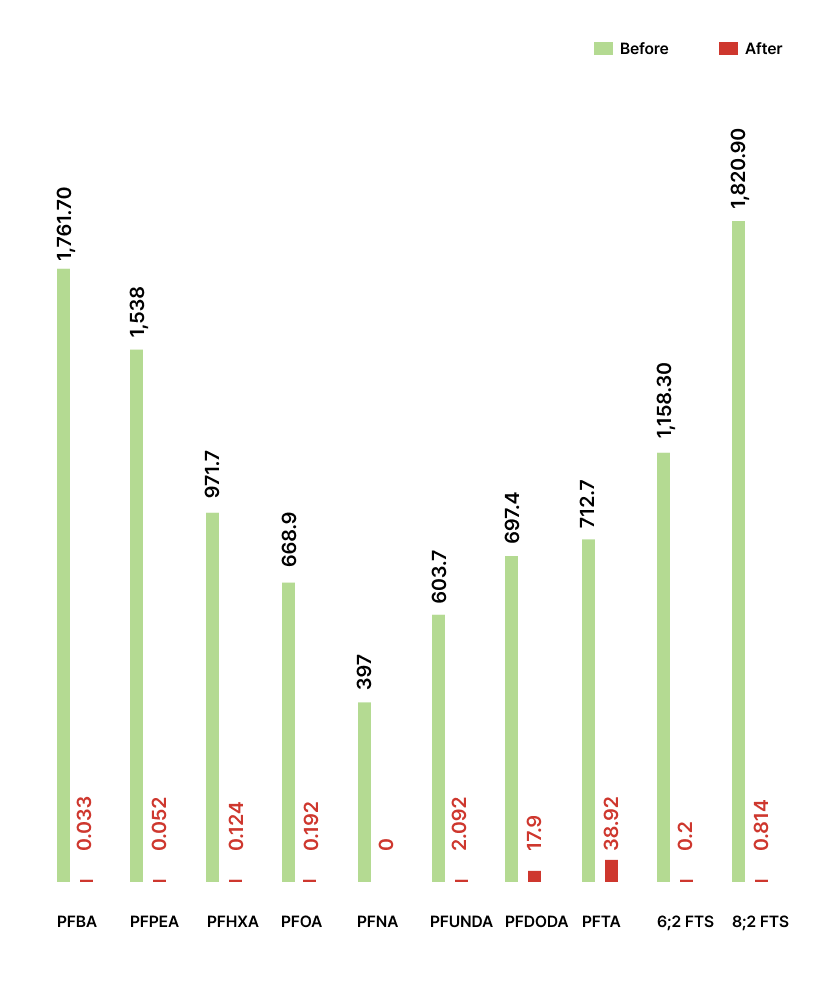
PFAS Group Degradation
Focused ultrasonic energy cleaves strong C–F bonds and
sequentially shortens long carbon chains of highly toxic chemicals,
which inhibit biodegradation, enabling effective decomposition.
| Target Substance | Molecular Formula | Before Treatment [ppb] |
After Treatment [ppb] |
Reduction Rate [%] |
|---|---|---|---|---|
| PFBA | C₃F₇COOH | 1,761.7 | 0.033 | 99.99 |
| PFPeA | C₄F₉COOH | 1,538 | 0.052 | 99.99 |
| PFHxA | C₅F₁₁COOH | 971.7 | 0.124 | 99.99 |
| PFOA | C₇F₁₅COOH | 668.9 | 0.192 | 99.99 |
| PFNA | C₈F₁₇COOH | 391 | N.D. | 99.99 |
| PFUnDA | C₁₀F₂₁COOH | 603.7 | 2.092 | 99.99 |
| PFDoDA | C₁₁F₂₃COOH | 697.4 | 17.9 | 99.99 |
| PFTA | C₁₄F₂₉COOH | 712.7 | 38.92 | 99.99 |
| 6:2 FTS | C₈H₈F₁₃O₃S | 1,158.3 | 0.200 | 99.99 |
| 8:2 FTS | C₁₀H₁₀F₁₇O₃S | 1,820.9 | 0.814 | 99.99 |
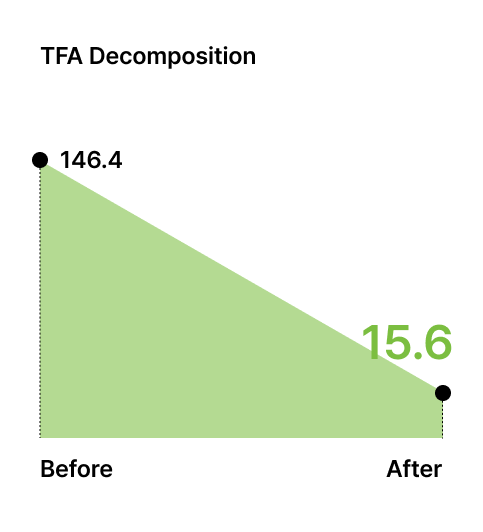
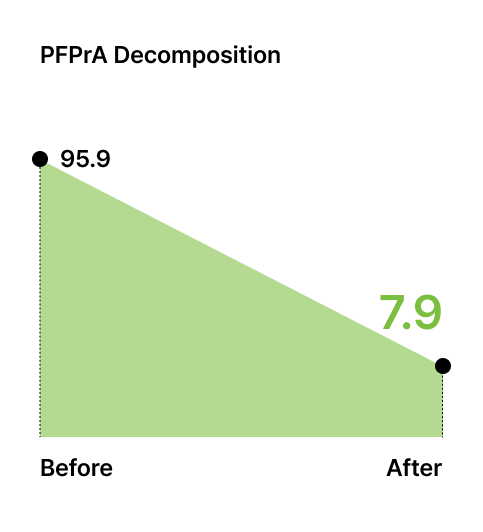
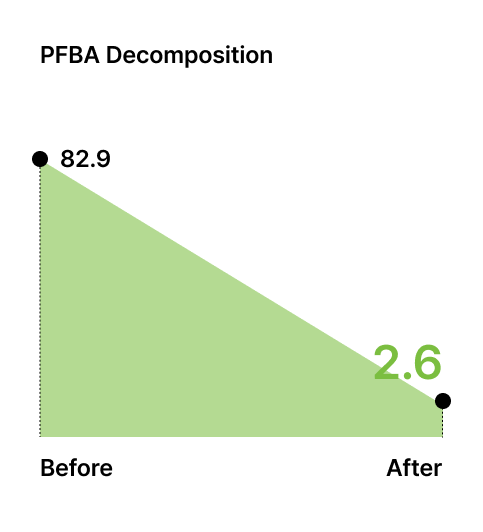
Short Chain PFAS Degradation
Short-chain PFAS are particularly difficult to treat and pose persistent risks to human health and the environment.
Even short-chain PFAS compounds with fewer than four carbon atoms can be effectively degraded.
Even short-chain PFAS compounds with fewer than four carbon atoms can be effectively degraded.
Mineralization
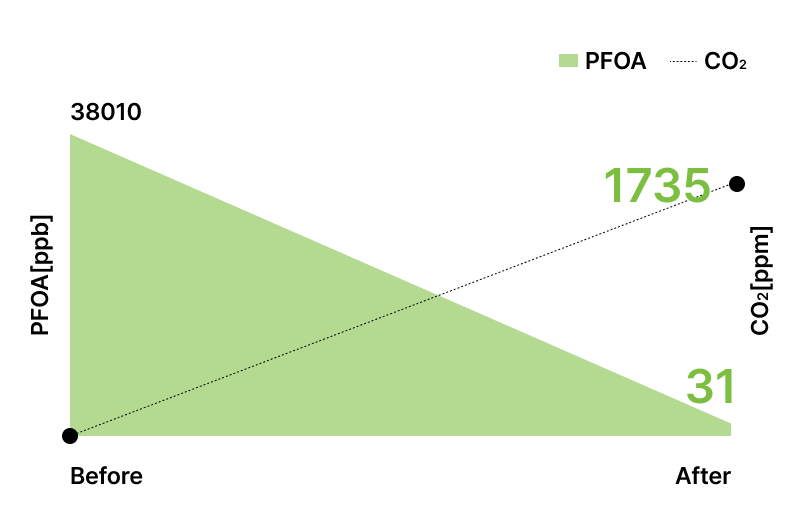
CO₂ capture before treatment: 0–400 ppm
CO₂ capture after treatment: 1,735 ppm
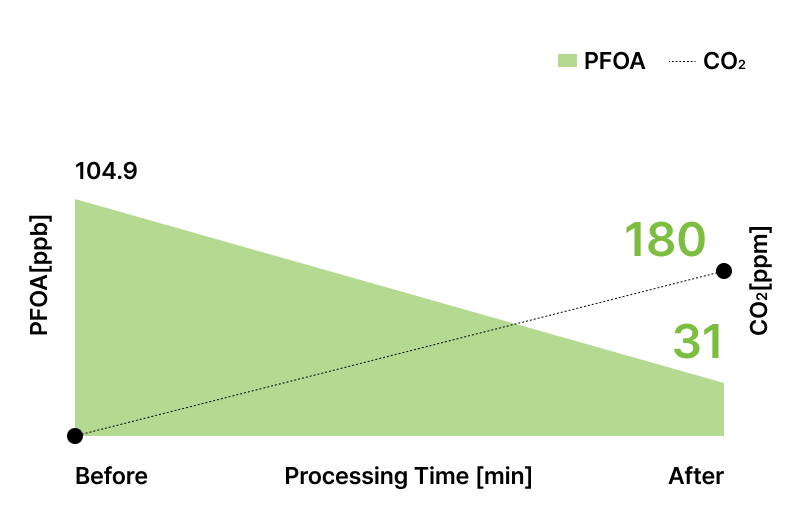
Detection of F⁻ after treatment confirms cleavage of C–F bonds through the ultrasonic process
Zebrafish Embryo Toxicity Assessment of PFAS-Treated Water
Toxicity evaluation conducted on CAVITOX-treated water containing endocrine-disrupting PFAS
Zebrafish embryo survival rate increased by 2–4 times
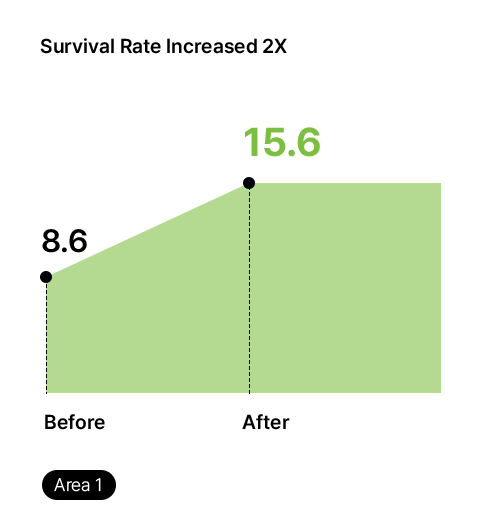
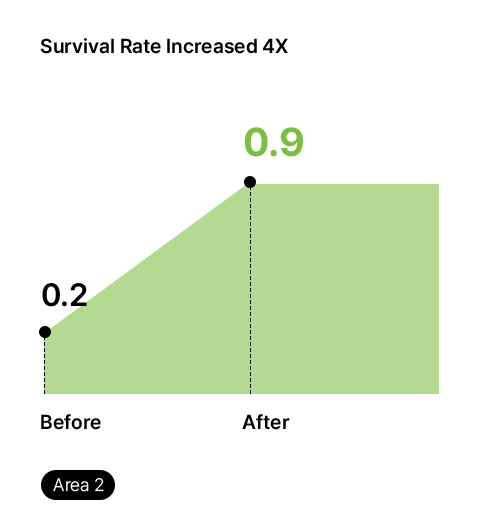
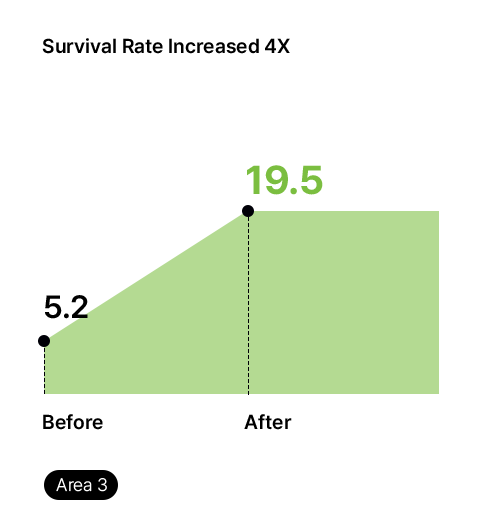
Lethal Dosage (LC50) Result
